Asian stocks tumble, bitcoin retreats as China enters bear market
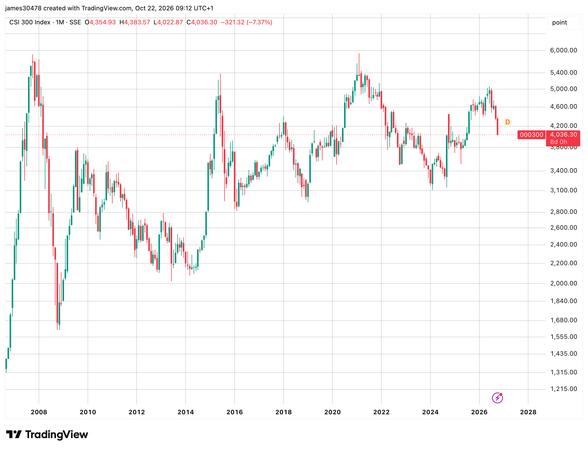
- China’s CSI 300 enters bear market territory, while stocks in Japan, South Korea and Hong Kong fall around 3% or more.
- Bitcoin retreats toward $82,000 as gold and silver decline, while rising oil prices add to market pressure.
Asian stocks tumbled on Thursday, with Chinese equities entering a bear market as technology shares sank and rising oil prices compounded investor concerns.
The CSI 300, which tracks the 300 largest stocks traded in Shenzhen and Shanghai, slid 2%, taking the decline from June’s peak to 20%. Other regional benchmarks followed suit. Japan’s Nikkei 225 fell around 3%, South Korea’s Kospi dropped 3.5%, Taiwan’s benchmark lost 2% and Hong Kong’s Hang Seng declined 3%.
Chinese technology shares traded in Hong Kong faced their worst session since President Donald Trump’s April 2025 “Liberation Day” tariff announcement, according to Bloomberg’s David Ingles.
According to Ingles, the technology benchmark has fallen more than 40% from its peak, almost erasing gains following Beijing’s Sept. 24 stimulus package, with forward valuations compressed to roughly 13 times earnings.
Mixed third-quarter earnings reports from U.S. companies added to the uncertainty surrounding artificial intelligence investment. Tesla TSLA fell around 3% after the market closed after cutting its capital-spending forecast, while Meta Platforms META raised the lower end of its spending guidance.
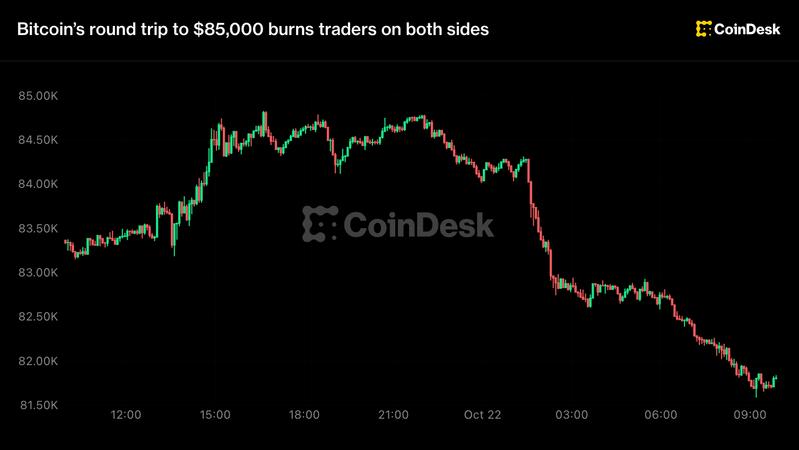
Bitcoin BTC$84,459.46 gave up its advance above $84,000, retreating toward $82,000. Gold fell more than 1% to below $4,100 an ounce, while silver dropped over 3.5% to around $55. Nasdaq 100 index futures declined almost 2%.
The Cboe Volatility Index, or VIX, jumped 10% to around 18, roughly 30% above September’s low. Meanwhile, WTI crude topped $100 a barrel and Brent crude climbed above $112 to the highest levels since May.
The equity selloff persisted despite easing Treasury yields, which would tend to make stock-market investments more attractive. The U.S. 10-year yield stood near 5.077%, below its recent peak around 5.4%.
Newsletters

- 1Crypto traders price India telecoms company Reliance Jio's IPO at about $110 billion15 minutes ago
- 2Live updates: Bitcoin’s round trip to $85,000 burns traders on both sides39 minutes ago
- 3China seeks to seize 61,800 BTC tied to $5.7 billion fraud scheme4 hours ago
- 4Solana’s biggest network change since 2020 is live. Here’s how users benefit5 hours ago
- 5Bitcoin ETFs attract $1.08 billion in 3 days but it may not be enough for a steep rally5 hours ago
- 6XRP Ledger bug fix moved to November after validator support dipped for two hours5 hours ago
- 7Bitcoin gives back its run at $85,000 as Tesla and Meta fail to calm AI nerves6 hours ago
- 8Trump to throw spotlight on overseas crypto abuses at White House event18 hours ago
- 9How a16z-backed DATA is rethinking its blockchain strategy after $30 million Sui deal19 hours ago
- 10Bybit will look for big broker partnerships to take on Robinhood in the U.S.19 hours ago
Beyond the Risk-Free Rate: Diversified Real World Yield in Productive Stablecoins

Beyond the Risk-Free Rate: Diversified Real World Yield in Productive Stablecoins
Diversified RWA stablecoins sustain 5-7% yield from real credit as crypto funding compresses to ~4%. GENIUS pushes yield off-chain; TAM grows to $4B in 3 years.
Diversified RWA stablecoins sustain 5-7% yield from real credit as crypto funding compresses to ~4%. GENIUS pushes yield off-chain; TAM grows to $4B in 3 years.
Why it matters:
Diversified RWA stablecoins sustain 5-7% yield from real credit as crypto funding compresses to ~4%. GENIUS pushes yield off-chain; TAM grows to $4B in 3 years.

Crypto traders price India telecoms company Reliance Jio's IPO at about $110 billion

China seeks to seize 61,800 BTC tied to $5.7 billion fraud scheme

Bitcoin ETFs attract $1.08 billion in 3 days but it may not be enough for a steep rally
Crypto traders price India telecoms company Reliance Jio's IPO at about $110 billion

Live updates: Bitcoin’s round trip to $85,000 burns traders on both sides
China seeks to seize 61,800 BTC tied to $5.7 billion fraud scheme
Related stories

Chinese Prosecutors Seek to Confiscate $5.1B in Bitcoin Seized by UK in Qian Case

Bitcoin ETFs draw $528 million as ether funds snap five-day outflow streak
Live updates: Bitcoin’s round trip to $85,000 burns traders on both sides